


|
 |




Teresa Teng Forever
Page 9 of 10
Thereafter, however, as the Chinese music scene became more diversified, new artists pushed the
old aside, and Teng faded. Living abroad, she rarely made public appearances. Perhaps it was for
health reasons. Perhaps she was tired of the grind and aspired to an unfettered life. Perhaps,
having already seen the world from the top, she had little interest in remaking her image. In
any case, she produced very few new works.
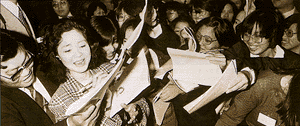 Then came 1989, and the Tienanmen Incident in mainland China. Teng, a supporter of the democracy
movement, made her sympathies known through song on many occasions in Taiwan and Hong Kong,
making a deep impression. A few days ago Wuerkaixi, one of the leaders of the demonstrators in
Tienanmen Square, recalled that in 1993 he and a few fellow-exiles in Paris met on June 6 to
commemorate their friends who died in 1989. Teresa came to pay her respects. Standing there
before the Place des droits de l'homme, she broke down in tears before finishing even one song.
And when she left, she said, in her quiet, sincere way, "no compromise with dictators, no giving
in to tyranny."
Then came 1989, and the Tienanmen Incident in mainland China. Teng, a supporter of the democracy
movement, made her sympathies known through song on many occasions in Taiwan and Hong Kong,
making a deep impression. A few days ago Wuerkaixi, one of the leaders of the demonstrators in
Tienanmen Square, recalled that in 1993 he and a few fellow-exiles in Paris met on June 6 to
commemorate their friends who died in 1989. Teresa came to pay her respects. Standing there
before the Place des droits de l'homme, she broke down in tears before finishing even one song.
And when she left, she said, in her quiet, sincere way, "no compromise with dictators, no giving
in to tyranny."
Perhaps some people feel that Teng became overly politicized. "But," interjects Kong Qiesheng,
"I had immense respect for her basic sense of morality. She never had any mixed good-and-bad
judgments about the Tienanmen incident. She was always deeply pained about the martyred
compatriots there, and she had great empathy for others and would have liked to alleviate all
the suffering of mankind." These are feelings that one would think all people should have, but
Teng felt them very sincerely, and unreservedly expressed them.
A pop music classic
Let us go a step further to understand Teng and her significance for Mandarin pop music. Yeh
Yueh-yu, a scholar of cultural theory, pointed out in an in-depth analytical piece that,
attractive as Teng's voice undeniably was, there are different interpretations of her historical
significance. Because she presented a soft and gentle mood aimed at warming the hearts of men,
feminist theorists might say that she is the classic product of the culture of a male- dominated
society. But cultural theory emphasizes the right of women to express their femininity, and
Teng's songs do just that. "People listen to pop music to play a role and focus on themselves,
because it gives people a chance to place themselves in the position of the character in the
song."

9
| Contact and Feedback |
|


