



| Since 15 August 1996. |
|
|
|
|
            
|
|




Teresa Teng Forever Page 7 of 10 Teresa arose in Taiwan in an era lacking in stars. Culture critic Weng Chia-ming divides Taiwan's Mandarin pop song history into several stages, including the Teresa-Teng-dominated 1970s; the Feng-Fei-fei-dominated early 1980s; the mid- to late-1980s, which were the heyday of campus folk music; and the 90s, which are the era of commercialized "music factories."
After Japan and the United States broke diplomatic relations with the ROC (in 1974 and 1978, respectively), the political atmosphere in Taiwan was rather clouded. As Taiwan's first international-level star, "she had the same inspirational impact as the Little League baseball champions," says Weng. Further, she continued to come back to participate in national day festivities and to perform for the armed forces, giving a considerable boost to people's morale.
Nevertheless, suggests Magic Stone Music general manager Landy Chang, before her voice reached
into the mainland she was still just one of a group of leading stars. It was only after her
music penetrated the mainland that she truly established her status as a superstar.
Mainland China at the end of the 1970s was still recovering from the debacle of the Cultural
Revolution. Music from the Cultural Revolution was heavy-handed and stiff, and was weighed down
by the responsibility of carrying the correct political message. As Kong Qiesheng, a mainland
writer living in the US, describes it, "It became a propaganda tool to promote Mao's ideas, just
like party newspaper editorials and critical articles." After Deng Xiaoping took power, there
was some easing up in the political realm, and only then were limited amounts of Hong Kong and
Taiwan music allowed in.
|
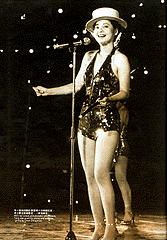 Back in those days, there were so many things to be done, the atmosphere was powerfully affected
by anti-communism, and people felt stifled. Opines Weng Chia-ming, "Let's put it this way: The
only real solace for Taiwanese was to be found in Little League baseball champions, Yang
Li-hua's Taiwanese opera, and Huang Chun-hsiung's puppet theater. The only thing mainlanders had
to look forward to, besides seeing their favorite singers on TV programs like 'Galaxy of the
Stars' or 'Milky Way Palace," was Teresa Teng!" Weng points out that Mandarin pop music in
Taiwan traces its roots back to Shanghai pop music, and Teng can be seen as the heir to that
tradition. Her ballads are infused with the sense of longing many mainlanders felt for their old
homes. Her songs allowed people a momentary escape from reality and "massaged" their
feelings."
Back in those days, there were so many things to be done, the atmosphere was powerfully affected
by anti-communism, and people felt stifled. Opines Weng Chia-ming, "Let's put it this way: The
only real solace for Taiwanese was to be found in Little League baseball champions, Yang
Li-hua's Taiwanese opera, and Huang Chun-hsiung's puppet theater. The only thing mainlanders had
to look forward to, besides seeing their favorite singers on TV programs like 'Galaxy of the
Stars' or 'Milky Way Palace," was Teresa Teng!" Weng points out that Mandarin pop music in
Taiwan traces its roots back to Shanghai pop music, and Teng can be seen as the heir to that
tradition. Her ballads are infused with the sense of longing many mainlanders felt for their old
homes. Her songs allowed people a momentary escape from reality and "massaged" their
feelings."